How Lean Teams Can Stay Ahead of Shorter AML Review Cycles
Learn how lean compliance teams can adapt to the EU’s shorter AML review cycles. Practical strategies to stay efficient under tighter AML regulations.

Why AML Review Cycles Are Getting Shorter in the EU
The European Union’s new Anti-Money Laundering (AML) package is more than just a regulatory update – it's a paradigm shift. With the formal establishment of the Anti-Money Laundering Authority (AMLA), increased harmonization across the bloc, and stricter supervision mechanisms, compliance teams – especially lean ones – are now under pressure to act faster and smarter. Among the biggest operational changes are shortened review cycles, where even low-risk customers now demand closer, more frequent scrutiny.
Let’s look at what’s actually changing:
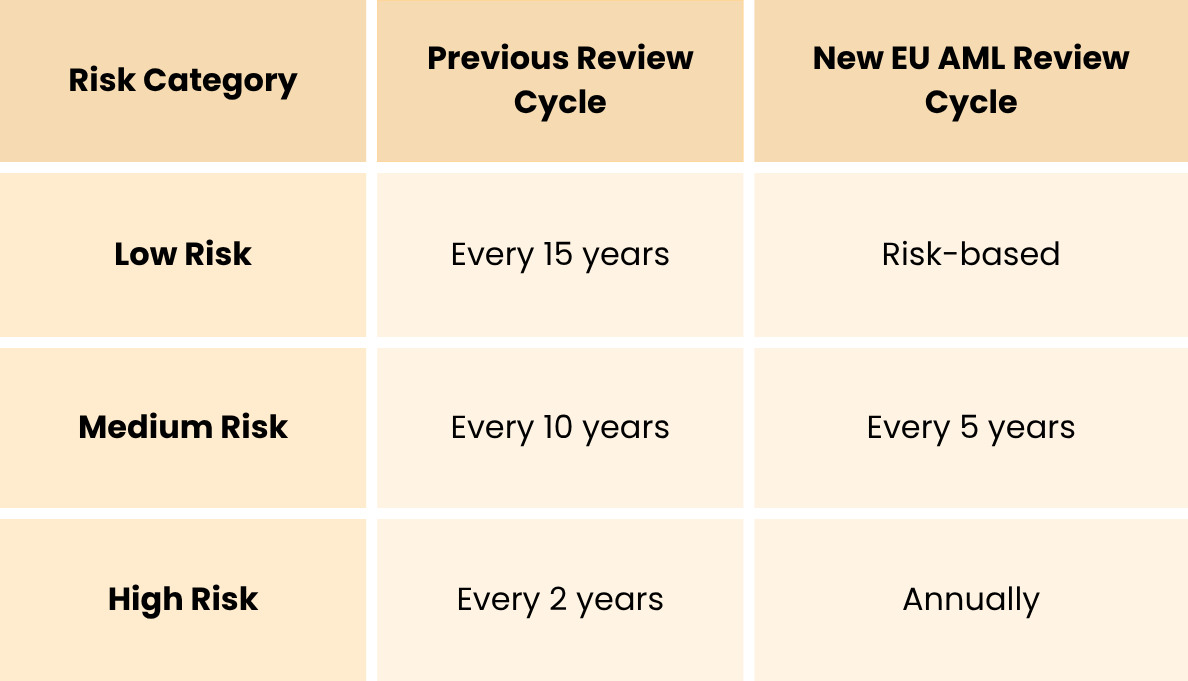
For lean compliance teams, this means hundreds – or even thousands – of additional reviews every year, with no proportional increase in headcount. Manual processes simply won’t keep up. Yet, when used correctly, technology like Sinpex reduces the workload and it helps teams thrive under the new regulation.
Here’s how.
Step 1: Automating the Repetitive, So People Can Focus on What Matters
Most AML teams still spend the bulk of their time doing repetitive tasks: fetching and verifying documents, investigating the UBO manually, verifying IDs, running name screenings through PEPs, sanctions lists and adverse media, or copying and pasting KYC data from one system to another. Sinpex eliminates all of these low-value steps through intelligent process automation. Sinpex enables analysts to skip the busywork and spend their time on real risk-based decisions.
Step 2: Centralizing Customer Intelligence to Minimize Fragmentation
When reviews are scattered across email threads, spreadsheets, and legacy systems, context is lost – and time is wasted. Sinpex consolidates all relevant information in one place. Whether it's UBO structures, previous review notes, or enhanced due diligence flags, Sinpex gives reviewers a complete customer profile, updated in real time. The result? Incredibly fast reviews and fewer errors. In a high-stakes environment, clarity isn't just a convenience – it's a compliance imperative.
Step 3: Risk Scoring in Real Time, Not in Retrospect
The EU AML package places new emphasis on ongoing risk monitoring, which means static risk scoring is no longer enough. Sinpex incorporates dynamic risk scoring that evolves with your customer’s behavior and profile changes. If a previously low-risk entity starts transacting in high-risk jurisdictions or expands ownership into opaque structures, Sinpex surfaces that insight automatically – triggering earlier intervention without having to wait for a scheduled review.
Step 4: Enabling Fast, Contextual Collaboration for Distributed Teams
In lean teams, efficiency breaks down when collaboration is clunky. Sinpex is designed with built-in case workflows, escalation logic, and internal commenting. Need Legal’s input on a complex trust structure? Want to escalate a flagged document for manual override? You can do it in-platform, without switching tabs or losing audit traceability. That’s how small teams stay aligned, even when distributed or operating under time pressure.
Step 5: Learning and Improving with Every Review Cycle
Most compliance teams treat KYC reviews as point-in-time obligations. Sinpex takes a different view - each review is an opportunity to learn. With machine learning models that are trained on your team's decisions and audit outcomes, Sinpex improves with every case. Over time, this reduces false positives, sharpens flagging accuracy, and boosts your team's confidence in the system’s recommendations. You’re not just speeding up the process – you’re elevating the entire quality of compliance.
The Bottom Line
With review cycles shortening across every risk tier, lean teams can no longer afford to treat compliance as a static checklist. Speed and intelligence must go hand in hand. By deploying modern tools like Sinpex, teams can adapt to the new AML landscape without burning out or falling behind. Compliance doesn't have to be a burden – it can be a strategic edge.
What’s new
Countdown AMLR 2027: What Operations and Risk Need to Decide Now
What the EU AML Regulation means from July 2027 for AML Officers, Risk and Operations. A Deloitte and Sinpex webinar with two real project examples.

EU AML Regulation (AMLR) 2027: what changes for KYB at banks and PSPs
The AMLR applies from 10 July 2027. What the EU AML Regulation changes for due diligence, beneficial owners, screening and records at banks and PSPs.
Ultimate beneficial owner (UBO) under the AMLR: how to identify beneficial owners from July 2027
From July 2027 the AMLR decides who counts as an ultimate beneficial owner. What the new definition means for banks, PSPs and their UBO files.
Sanctions screening and PEP screening under the AMLR: who must be screened, and how deep
Sanctions screening and PEP screening under the EU AMLR: who must be screened, when to screen again and what a PEP match requires from banks and PSPs.
